Sunday, October 28, 2012
Ocean acidification - is it a problem?
Let us look at hard facts.
One hard fact is that in the past Earth had much higher CO2 concentrations in the atmosphere, which had not reduced biodiversity - on the contrary, biodiversity had increased - namely, hard corals came into existence in one of such periods, and soft corals in another.
Another hard fact is that for significant "acidification" to take place in nature, the dissolved acidic CO2 in the oceans should increase, without being compensated by the basicity of the dissolved calcium (and magnesium) ions. In practice, this can never happen for a very simple reason - the CO2 concentrations are not growing quickly enough for that.
Indeed, assuming that we continue burning as much fossil fuels as we want, then we expect the atmospheric CO2 concentrations to double by 2100, with a characteristic time of about 150 years. On the other hand, the characteristic mixing time of the upper ocean is about 20 years, while the characteristic pH equilibration time of the shallow-water biologically productive zones inhabited by calcifying biota is about 10 years. The latter time was estimated based on the annual volume of the river runoff and the amount of seawater existing in the coastal shallow-water zones. These numbers tell us that calcium (+magnesium) will be perfectly capable of accompanying the increasing concentrations of carbonate ions, maintaining the pH of the seawater fairly constant. In fact, it will never change by much more than it has already changed during the last century (0.1 pH), as the entire process has already achieved steady rates in some 70 years since it had started (70 years is much more than 20 years, mathematically speaking, therefore the non-steady initial kinetic phase has already finished).
There is an additional factor that helps to equilibrate carbonate with calcium (+magnesium), namely the chemical equilibrium. We know that the solubility of acidic carbon dioxide in pure water is lower than its solubility in water containing basic calcium (and magnesium) ions, therefore additional CO2 will actually dissolve in seawater after it acquires additional amounts of basicity, brought in by the river runoff from the continents, and not before. This factor further reduces the possible pH changes of the seawater.
As regards calcifying biota, it will certainly benefit from the increased dissolved carbonate and dissolved calcium (+magnesium), in the same way as plants benefit from increased atmospheric CO2. More CO2 implies higher agricultural yields and higher seafood yields, all in benefit of humanity.
In two words: ocean acidification is a scam, same as the anthropogenic global warming. This hoax, however, is providing for thousands of careers of pseudo-scientists who make their living of studying nonexistent problems, using our tax money to defraud us and earn grants and distinctions.
Ocean acidification is a moral and a criminal problem, rather than an environmental problem. Environmentally, it is not a problem, and will never become a problem.

Saturday, October 20, 2012
Methanol generated from aspartame - is it dangerous?
International official documents recommend that concentration of methanol in food should not exceed 8 ppm (parts per million). Given the average annual food consumption of some 700 kg per person, this amounts to 15 mg of methanol deemed safe to ingest daily. On the other hand, safe daily intake of aspartame had been defined at about 50 mg/kg, or 3500 mg per 70 kg adult.
Now we go to the formula of aspartame, in order to deduce the amount of methanol that will be generated in our body by 3500 mg of aspartame. A simple stoichiometric calculation tells us that 3500 mg of aspartame, upon hydrolysis in our stomach and guts, will produce 380 mg of methanol. This value exceeds by 2500% the safe levels for methanol ingestion.
This simple calculation shows that the "safe" levels of aspartame consumption had been grossly overestimated, and should be reduced by at least a factor of 100. Note that we need no clinical tests to come to this conclusion, our knowledge of chemistry has been more than sufficient.
Baseline: if you care about your health, stay away from artificial sweeteners, "diet" drinks and such like. Otherwise, you are subjecting yourself to inadmissible levels of methanol.
Wednesday, October 10, 2012
Défice Tarifário e Energias Renováveis
A complementar o meu post antigo:
Hoje foi anunciada na comunicação social a existência de um "défice tarifário", no valor de 2700 milhões de euros, dos consumidores de electricidade, aos produtores de electricidade. Um consumidor doméstico, na média, fica a dever um montante à volta de 500 euros, já que são os consumidores domésticos que pagam a factura das renováveis. Por outras palavras, as extravagâncias das energias renováveis estão a ser pagas, durante anos, pelos empréstimos bancários, em vez das tarifas de electricidade. Ou seja, o consumidor vai acabar por pagar tudo o que deve, com aumentos das tarifas de electricidade, e ainda os juros devidos aos bancos ...
Ora, as políticas governativas continuam a ser motivados pelo moral dum aldrabão: " ... esperemos que o povo não note que está a ser roubado ..."
Preparem-se: as tarifas de electricidade, para cumprirmos as metas verdes, terão que subir 200%. Na Alemanha, os preços da electricidade vão subir 50% já em 2013, graças aos moinhos de vento.
Tuesday, September 11, 2012
Science: Food prices are pushed up by Biofuels
To complement my earlier post, here is the plot derived from a model that deduces world food prices from the behaviour of speculators and, most importantly, from the amount of corn ethanol produced in the US, the major corn exporter and biofuel producer.

The two papers presenting the original research results may be consulted here (the model), and here (additional verification of the model) - you can download the respective PDF files free of charge. The plot was taken from the second paper.
The plot shows model results (two different versions of the model; in green and red), compared to the actual evolution of the food price index, in blue. Note an excellent agreement between the real-world data and the model predictions. The dashed blue line shows the food price evolution if we remove the contribution of the speculators/investors to the price evolution - the equilibrium model. The action of speculators produces food price peaks. Such peaks have appeared in 2008 and 2011, with a new peak predicted for 2013-2014.
Therefore, now we have conclusive evidence that green fuel production is in fact driving the food prices up, causing additional deaths from starvation in poor nations, or the green genocide. Note that the number of deaths by starvation is directly proportional to the food price index. Green fuels are immoral and criminal.
Monday, September 10, 2012
Positive feedback between Food and Energy prices
The plot below compares the evolution of the monthly Food Price Index to that of the monthly Energy Price Index. The data were taken from the site Index Mundi. Descriptions:
- Commodity Food Price Index, 2005 = 100, includes Cereal, Vegetable Oils, Meat, Seafood, Sugar, Bananas, and Oranges Price Indices
- Commodity Fuel (energy) Index, 2005 = 100, includes Crude oil (petroleum), Natural Gas, and Coal Price Indices
 |
| Food price index compared to Energy price index |
We also note that since around the year 2000, when the drive for renewable energies and green fuels started on a large scale, both energy and food prices are following an exponentially growing trend. The growth in energy prices is caused by various political measures aimed at introducing renewable energies, which are much more expensive (200% to 900% difference) and have to be heavily subsidized. This growth automatically drives the food prices up. The production of green fuels, which in some cases uses up to 25% of the currently produced foods, is another factor that is driving up the food prices, by increasing demand. The positive feedback mechanism between food and energy prices acts via green fuels: more expensive foods result in more expensive green fuels, which in turn make foods even more expensive. This positive feedback acts since the year 2000.
Complementing our reasoning presented in an earlier post, it is not only green fuels that kill people by starvation, but also the renewable energies. What we need is cheaper energy and cheaper food, and not the other way round. Therefore, recalling our posts on climate issues that demonstrate the lack of ecological justification for renewable energies and green fuels, the sooner we drop these useless projects, the lower will be the number of people dead from starvation in African and other poor nations.
Sunday, July 1, 2012
Crise de Dívida Pública e o Ministério Público
Surpreendentemente, ninguém até agora perguntou, por que razão os Ministros de Economia e os governos tenham proposto, e a Assembleia da Republica aceite, durante 15 anos, os orçamentos deficitários? Ora uma dona de casa consegue perceber, que não se pode pedir dinheiro emprestado para financiar os gastos correntes, mas os srs. políticos, altamente qualificados, não conseguem perceber o mesmo?! Incompetentes ou mal intencionados? Devem ser julgados pelo crime de gestão danosa, já que o dolo é bem evidente - não podiam não saber o que estavam a fazer.
Onde é que está o Ministério Público?
Saturday, June 30, 2012
Scientific Method against the Anthropogenic Global Warming Scam
A simple way to talk about complex issues.We start with the definition of the Scientific Method. This particular version belongs to Richard Feynman (1918-1988): "In general we look for a new law by the following process. First we guess it. Then we compute the consequences of the guess to see what would be implied if this law that we guessed is right. Then we compare the result of the computation to nature, with experiment or experience; compare it directly with observation, to see if it works. If it disagrees with experiment it is wrong." An important consequence of this definition is that a single piece of contradicting evidence is sufficient for a hypothesis to be rejected, on the other hand, no amount of non-contradicting evidence may confirm or prove a hypothesis. Indeed, there always may be alternative hypotheses, some of them completely unknown to us, due to limitations of both our current knowledge and our thinking.
Let us now assume, as a hypothesis, calling it Hypothesis A, that the IPCC climate models, which attribute the recent warming of climate to anthropogenic emissions of carbon dioxide, correctly describe the properties of our terrestrial climate system. To reject this hypothesis, we need at least one piece of contradicting experimental evidence. Such evidence had been provided in the paper by R. Lindzen and Y.-S. Choi, "On the determination of climate feedbacks from ERBE data", Geophys. Res. Lett. vol. 36, pp. L16705, 2009.
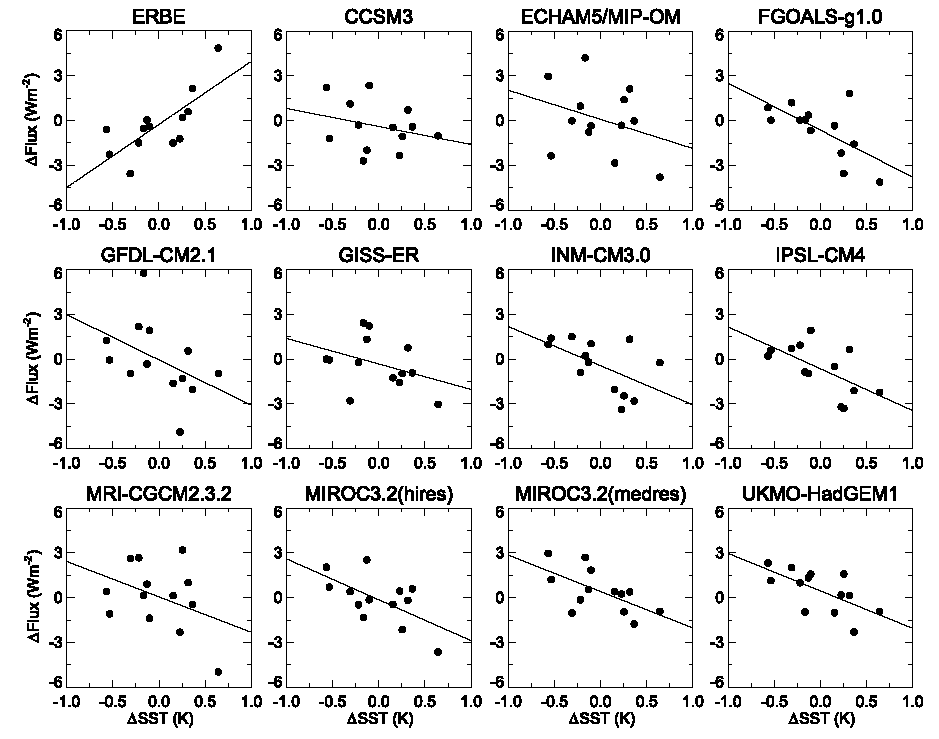
The above Figure from their paper (their Fig. 2) compares the experimental response of the climate system (the amount of infra-red and visible radiation escaping from Earth to outer space) to the increase in surface temperature, as measured by the ERBE satellite, the upper left plot (marked ERBE), to the responses of the eleven different IPCC climate models (the remaining plots, marked by abbreviations of the respective models). As we see, all of the models respond in the wrong way, opposite to the real climate system. We have to conclude that our Hypothesis A is incorrect; in other words, the IPCC climate models do not describe the climate system in an appropriate way. One piece of evidence we have shown is sufficient for the conclusion we made, the conclusion being necessary and inevitable consequence of this piece of evidence.
Let us now assume a Hypothesis B, namely, that the IPCC models are able to predict future climate. As we already saw, the models that attribute the recent warming to the effect of greenhouse gases, in particular carbon dioxide, do not appropriately describe the properties of the real terrestrial climate system. Therefore, we can't expect any reasonable predictions from such models, and our Hypothesis B has to be rejected, for the same reason that we rejected Hypothesis A. This time, contradictory evidence is provided by the fact that the models don't even describe the currently existing climate, therefore, without a built-in understanding of how the climate works, the models can't be expected to predict how it will evolve in future.
Our Hypothesis C, which we shall also test, is that IPCC during the 25 years of its existence has been doing something useful. The rejection of the above Hypotheses A and B demonstrates that Hypothesis C is wrong as well. Indeed, the IPCC Climate Predictions and Scenarios are based on their models, which are basically worthless. The IPCC Reports, at least in their part that describes future climate, should therefore be classified as pseudoscience, and expressly neglected in any serious discussion of future climate.
q.e.d.
As a side note, IPCC is obviously far too expensive for the scientific results it is producing, to say the very least.
Subscribe to:
Posts (Atom)